
Project in the spotlight: Meise Botanic Garden
At the request of the Flemish Energy Company, we helped make the heating installations at Meise Botanic Garden more sustainable, from concept to execution.

The Flemish Energy Company (Vlaams Energiebedrijf, VEB) is an agency of the Flemish government that helps public services, schools, cities and municipalities make their buildings more energy-efficient. De Klerck Engineering has had a framework agreement with the VEB for many years and, through it, has completed numerous projects, including relighting projects for De Lijn and boiler room renovations for several cities, among them Kortrijk.
In 2022, we were asked to carry out a study on making Meise Botanic Garden more sustainable. Both the buildings and the greenhouses were still heated entirely with natural gas. There was a clear wish to switch step by step to a more sustainable alternative and make the site future-proof.
A high heat demand
The botanic garden is a site with a very high heat demand. Dozens of buildings are spread across the estate, including 2 large greenhouses with, among others, specific wings for tropical plants that need to be heated to high temperatures all year round. The boiler house, which used to be a coal-fired power station, contained several gas boilers with a total capacity of 14 MW and a CHP unit to supply heat to the entire site. We developed a design that allows heating at both high and low temperatures, taking into account the budget and the existing infrastructure, with the option of becoming even more sustainable in the future.
Our approach
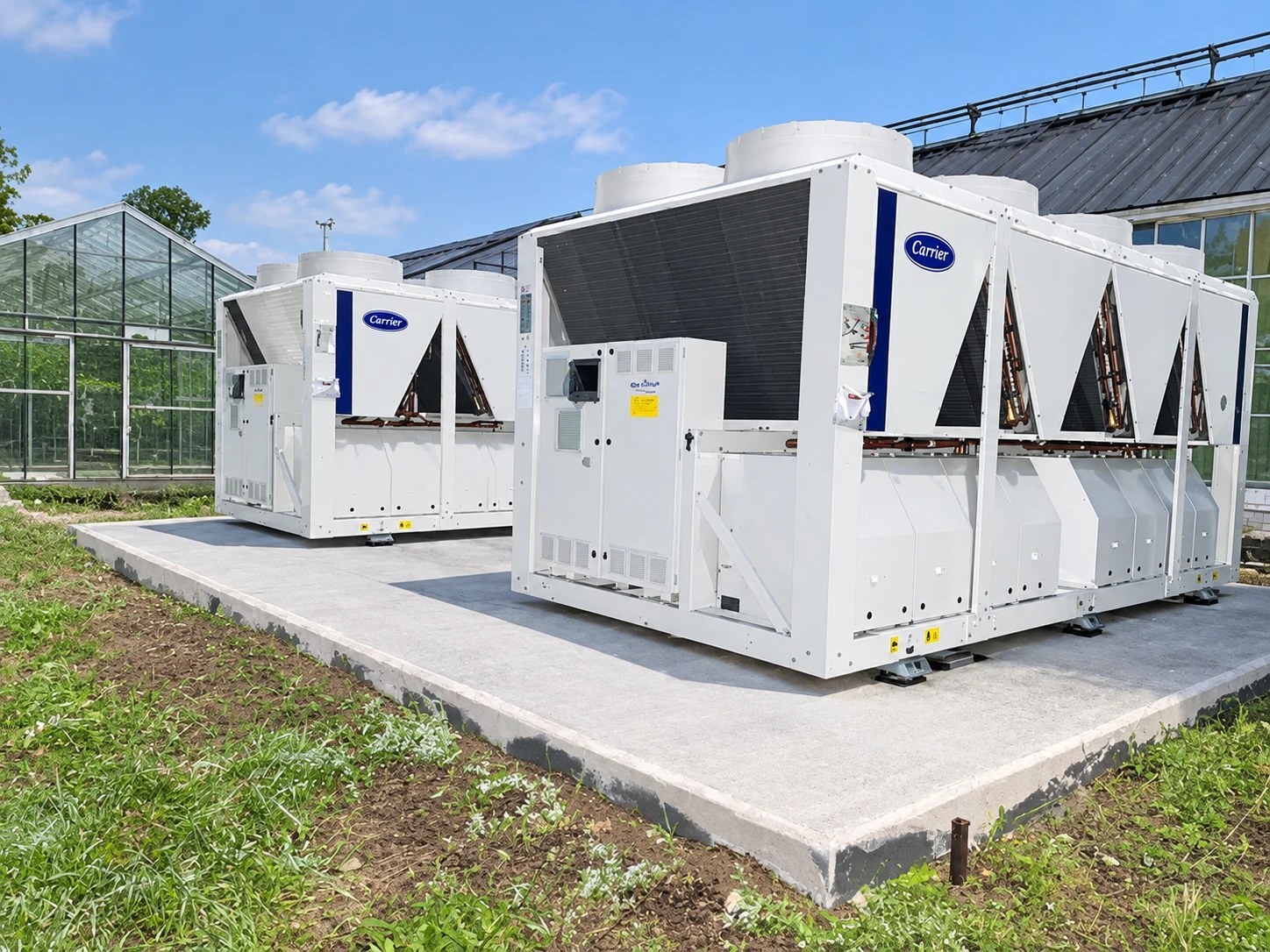
Gregory Verhaeghe, project manager: “As with every project, we started with a feasibility study. The botanic garden asked to switch to a heating system based on geothermal energy. But our study showed that this was not worthwhile. There is little to no cooling demand on the site and a very high heat demand. Because of that imbalance, a borehole thermal energy storage (BTES) field was not cost-effective. We worked out several scenarios, and together with the client we ultimately chose a combination of 2 air-to-water heat pumps of 500 kW each and an additional CHP unit, while keeping the existing gas boilers. That way, we could continue to heat the older buildings with high-temperature water.”
The optimal combination
Combining different systems naturally requires good management. That is why a building management system with intelligent control was chosen to optimise energy costs and CO2 emissions.
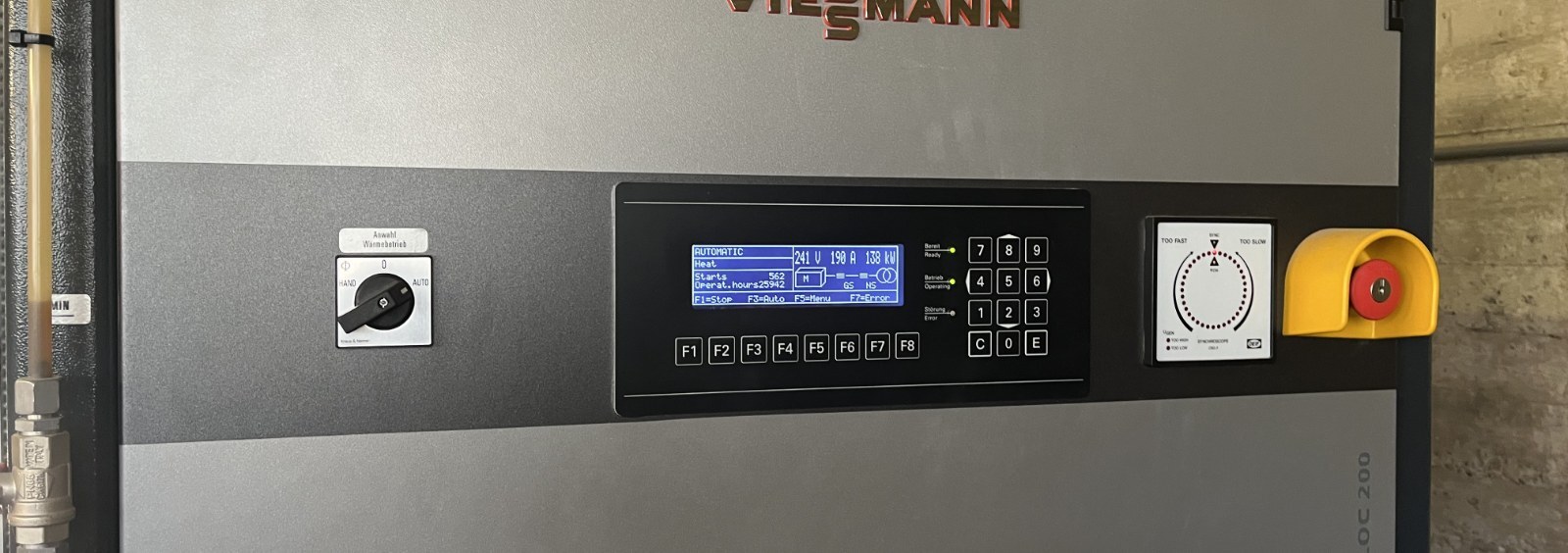
Gregory: “The heat pumps supply energy for low-temperature heating. In summer and the intermediate seasons, this is sufficient. In the cold winter months, 1 greenhouse is heated with gas and a second greenhouse partly with gas and partly by the heat pumps. The management system automatically decides which heat generators are used, based on the outdoor temperature, on-site production and current electricity prices. The CHP units in turn generate the energy needed to power the heat pumps, supplemented with solar energy.”
Support during tendering and execution
As a multidisciplinary engineering firm, we go beyond design alone. We provided the VEB with a complete tender file, including detailed bills of quantities. We expertly analysed the submitted bids and assessed them for completeness and accuracy. Finally, we awarded the contract based on predefined award criteria. During execution, we also remained closely involved, supporting the contractor and carefully monitoring the work on site.
Well-considered placement of equipment
Every project has its challenges, and this one was no exception.
Gregory: “A logical location for both heat pumps seemed to be close to or on the existing boiler house. But since the building is located at the edge of the plot, there was a risk that the fans, while extracting heat from the air, would cause noise nuisance for nearby homes. It was therefore decided to place the units deeper within the estate, in the courtyard of one of the greenhouses. With the added benefit that they are not visually intrusive either.
The heat pumps are supplied with electricity via a new medium-voltage substation nearby and are connected to the site’s underground heating network. The result: less excavation work, reuse of existing pipes and therefore a lower cost.”
Planning a sustainability project of your own? We’re happy to think along with you.