
Grid congestion in Flanders: how we deal with it
Increasing electrification is putting more pressure on the electricity grid in Flanders. What does this mean for you as a client, and how does De Klerck Engineering deal with it? Kris Verhaeghe, Team Lead Electrical, explains.

The additional need for data centres, the rise of electric vehicles, the installation of charging points and heat pumps … More and more power is being demanded from the grid. Power that it cannot always supply. To be clear, there is no shortage of electricity. Quite the opposite. What there is, at the moment, is a shortage of capacity on the grid to transport it all at the same time.
Grid operators Fluvius and Elia are working on a joint action plan to reinforce and expand the grid in the future, but that obviously takes time. That is why Fluvius is also taking preventive measures to limit the risk of grid congestion, meaning an overload of the grid. It does so by offering a flexible connection to non-residential customers with high consumption: industry, hospitals, schools, care homes and so on. And that is an additional challenge for implementing sustainable solutions in those sectors.
“The flexible connection is an additional challenge for implementing sustainable solutions in certain sectors.”
What is a flexible connection?
With a flexible connection, part of the electrical capacity is guaranteed and another part is limited during peak times. For large consumers, this means that during grid congestion they do not receive the full capacity their installations require. It is crucial to take this into account in the design phase.
It is important to know that a flexible connection varies from location to location and is limited in time. The decision to grant the connection and its terms is made by the distribution system operator, based on the investment plans for reinforcing the grid in that specific region. We therefore advise clients to submit an official application to the distribution system operator as soon as possible, so that we as an engineering firm have the right information to develop a tailored solution.
How does De Klerck Engineering deal with it?
A temporary reduction in capacity is currently announced 3 minutes in advance. That is why it is important to act quickly and to be able to adjust consumption automatically. Implementing an energy management system (EMS) is indispensable here and is therefore a condition imposed when a flexible connection is granted.
“An EMS is a condition imposed when a flexible connection is granted.”
The EMS controls the various energy sources and ensures that consumption stays below the guaranteed capacity as much as possible by using as many consumers one after the other rather than at the same time. If consumption still exceeds the guaranteed capacity despite the energy management system, an alternative energy source is used, such as a battery system.
If a client is offered a flexible connection, then:
- we determine what capacity is needed, whether additional energy sources are required alongside the grid connection, and which type of energy source is most suitable (a battery energy storage system, a generator or a combination of both).
- we work out a scenario describing the steps the EMS will take when the available capacity is temporarily reduced. Together, we determine in which order which decisions are made to guarantee continuity with as little loss of comfort as possible.
“Together, we determine in which order which decisions are made to guarantee continuity with as little loss of comfort as possible.”
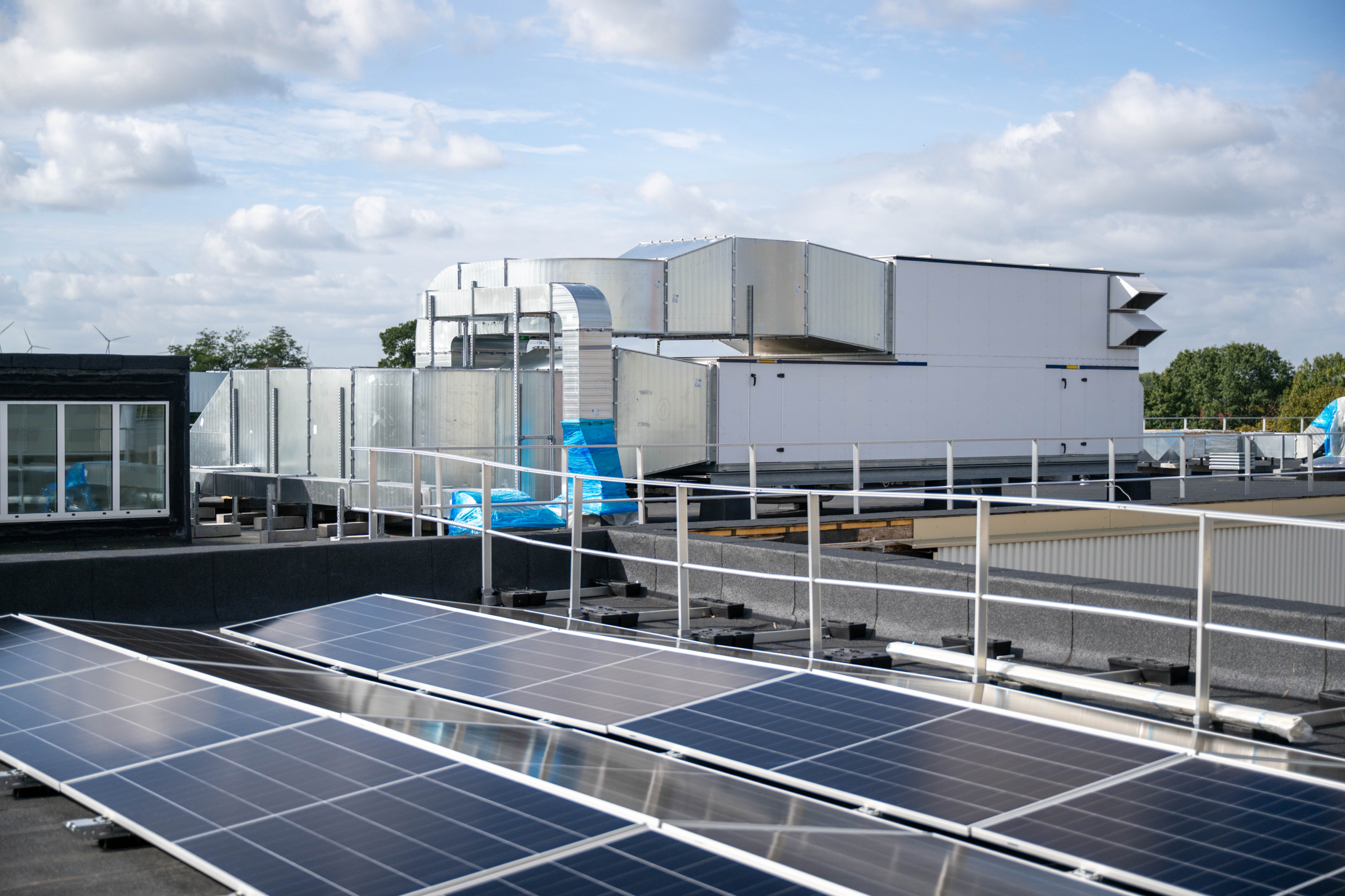
Some concrete examples of possible EMS controls
- Electric vehicles that only leave the site again in the evening are charged in the afternoon, when solar energy is available and large consumers such as the kitchen are not in use.
- Electric vehicles that are on site for a long time are charged one after the other, or two at a time at half power.
- Reducing ventilation when consumption temporarily needs to drop.
- In periods of low electricity consumption, the heat pump is used to ‘pre-heat’ or ‘pre-cool’ the building.
- At times when the power drawn from the grid needs to be limited, stored solar energy from the battery is used or the emergency generator is started.
- Surplus solar energy is directed to a battery energy storage system (BESS).
Battery energy storage system (BESS)
A battery energy storage system (BESS) controlled by the EMS is a solution we often turn to. Thanks to smart control, it can be used optimally and the payback period is shortened. It is ideal for:
- Increasing self-consumption of solar energy by storing surplus solar energy in the battery during the day and using it in the evening and at night.
- Peak shaving: absorbing peaks in response to the capacity tariff.
- Back-up: compensating for a power shortage during a temporary capacity reduction.
- Grid stabilisation: avoiding large feed-in when renewable energy is used.
- Energy trading: charging with cheap energy when there is oversupply, discharging when energy prices are high due to scarcity.
Conclusion
A thorough preliminary study and a tailored approach are the answer to the problem of grid congestion. On the Fluvius website, you can find everything about the grid congestion measures in Flanders.
Questions about grid congestion or a flexible connection for your project? We’re happy to look at it together.